
A novel bottom-up approach to design an in vitro model of the human intervertebral disc

IBV coordinator
Lidija Gradišnik
Duration
2025 – 2027
Back to the list
Short description
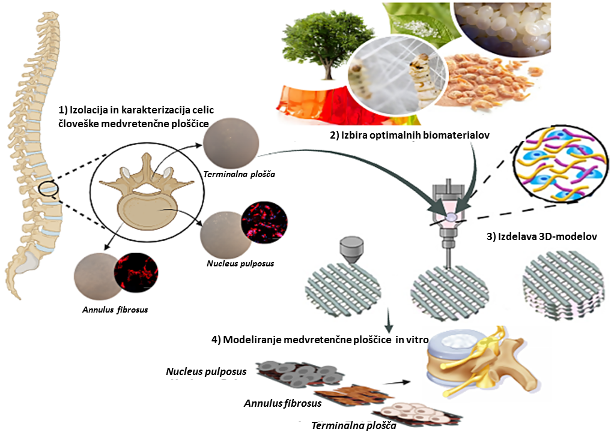
Intervertebral disc (IVD) degeneration is a common cause of low back pain, a major contributor to disability worldwide. The absence of commercially available, approved devices or therapies for IVD regeneration highlights the need for appropriate preclinical IVD models to unravel the complex pathophysiology and develop more effective treatments. Current in vitro IVD models rely on animal testing and animal-derived cells, and these results cannot be directly translated to humans. To establish a more credible in vitro experimental model and in line with global strategies to reduce animal testing, we are developing a concept for a human 3D in vitro IVD model (Figure) that can replicate the physicochemical and biological properties of the microenvironment of three critical IVD tissues: nucleus pulposus (NP), annulus fibrosus (AF), and cartilaginous endplate (CEP). To achieve this, the project focuses on five specific objectives: (1) to develop an optimised method for collecting tissue samples and an improved protocol for cell isoltion to increase cell yield; (2) to establish protocols for the isolation and characterisation of human NP, AF, and CEP cells from surgical specimens; (3) to develop model systems for determining optimal biomaterials; (4) to fabricate viable 3D scaffolds for all three IVD tissues; and (5) to assemble and validate the complete in vitro IVD model. In this way, the design of the in vitro human IVD model will provide valuable insights into pathophysiology od IVD degeneration and potential new treatment strategies.
The MF UM is the coordinator of the clinical project and will be involved in all work packages, with support from the partner – Department of Neurosurgery, University Medical Centre Ljubljana, particularly in specific research areas and methods